


Retirement income planning doesn't end when you stop working. One of the most important decisions you'll face is determining which retirement account to withdraw from first.
Many retirees have multiple sources of savings, including a 401(k), traditional IRA, Roth IRA, taxable investment accounts, and other assets. The order in which you use these accounts can affect your taxes, future Required Minimum Distributions (RMDs), investment flexibility, Medicare premiums, and how long your assets may last.
There isn't one withdrawal strategy that works for everyone. Instead, the goal is to coordinate your accounts in a way that supports your income needs while considering taxes, investment conditions, healthcare costs, and your long-term financial plan.
Different retirement accounts receive different tax treatment.
A traditional IRA and most traditional 401(k) accounts generally contain pre-tax dollars. Withdrawals are generally included in taxable income, except for amounts representing previously taxed basis. Roth IRAs, by contrast, can provide tax-free qualified distributions.
That means withdrawing $50,000 from one account may have a very different tax consequence than withdrawing $50,000 from another.
Your withdrawal strategy can also affect:
For this reason, retirement withdrawals should generally be considered as part of your overall asset management and wealth planning strategy, rather than as a simple "use this account first" rule.
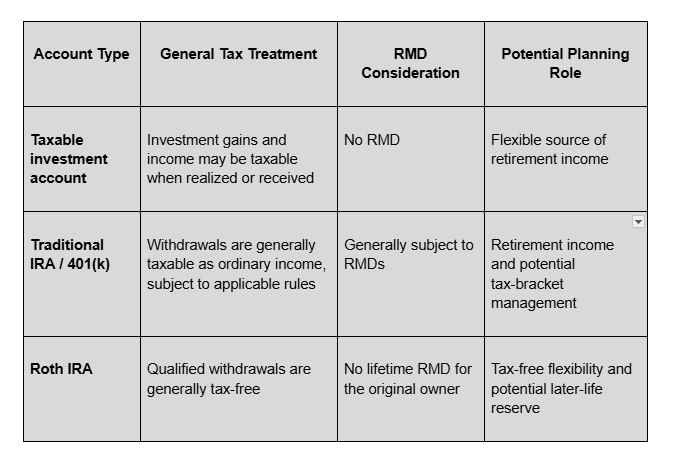
The table provides a starting point, but the appropriate withdrawal strategy depends on the retiree's entire financial picture.
Instead of following a fixed withdrawal hierarchy, consider reviewing several factors each year:
This approach recognizes that the most appropriate account to use can change from year to year.
For some retirees, taxable investment accounts may be an appropriate source of early retirement income.
Withdrawals from a taxable brokerage account generally aren't treated the same way as withdrawals from a traditional IRA or 401(k). Instead, the tax consequences depend on factors such as whether you're selling investments at a gain or loss and what type of income the investments generate.
Using taxable assets before tax-deferred retirement accounts can sometimes help manage taxable income during the early years of retirement.
However, there can also be reasons to use tax-deferred accounts earlier, particularly if you expect future RMDs or other sources of taxable income to create a larger tax burden.
The appropriate strategy depends on the individual's overall circumstances.
Traditional retirement accounts can become an increasingly important part of retirement income planning.
Under current IRS rules, RMDs generally apply to traditional IRAs and most employer-sponsored retirement plans beginning at age 73, although the specific rules can depend on the type of account, your date of birth, employment status, and other circumstances. Roth IRAs generally aren't subject to lifetime RMDs for the original owner.
This creates an important planning opportunity before RMDs begin.
Rather than waiting until required distributions dictate the amount you withdraw, some retirees may evaluate whether intentionally withdrawing from or converting portions of tax-deferred accounts during lower-income years makes sense.
This could include:
The objective isn't necessarily to minimize taxes in one particular year. It is to consider the long-term tax impact of the entire retirement period.
The years between retirement and the beginning of RMDs can be an important period to evaluate.
For example, someone who retires in their early 60s may no longer have employment income while not yet receiving Social Security or required distributions from traditional retirement accounts. That temporary reduction in taxable income may create an opportunity to evaluate Roth conversions, traditional IRA withdrawals, or a combination of account types.
The goal isn't automatically to convert as much as possible or eliminate future taxes. Instead, retirees can evaluate how today's decisions could affect future RMDs, Medicare premiums, Social Security taxation, and available assets later in retirement.
Roth conversions can create taxable income in the year of the conversion, so they should be evaluated in the context of the individual's broader tax and retirement plan.
A Roth IRA can be a valuable source of retirement flexibility because qualified Roth IRA distributions are generally tax-free, and Roth IRAs aren't subject to lifetime RMDs during the original owner's lifetime.
For that reason, some retirement strategies prioritize preserving Roth assets for later retirement.
However, "Roth last" isn't an absolute rule.
There may be situations where using Roth assets earlier makes sense—for example, to avoid generating additional taxable income or to help manage Medicare-related income thresholds.
A Roth IRA can also serve as a flexible reserve for large future expenses because qualified withdrawals generally don't increase taxable income.
The important consideration is how the account fits into the entire retirement income plan.
Your retirement accounts don't exist in isolation.
Social Security, pension income, annuities, employment income, and investment income can all affect how much you need to withdraw from your portfolio each year.
Additional taxable income can also affect the amount of Social Security benefits that is subject to federal income tax.
For example, a retiree receiving a pension and Social Security may have less need to withdraw from investment accounts than someone relying almost entirely on portfolio assets.
Likewise, delaying Social Security or coordinating pension income with portfolio withdrawals may change which account is most appropriate to access.
This is why retirement income planning should generally begin with your spending needs and guaranteed income sources before determining which investment account to draw from.
A Roth conversion is different from a traditional rollover.
When eligible pre-tax retirement funds are converted to a Roth IRA, the taxable portion is generally included in income for the year of the conversion, subject to applicable rules.
This is why retirees sometimes consider Roth conversions during years when their taxable income is relatively low.
For example, someone who retires at 62 but doesn't begin RMDs until later may have several years in which they can evaluate whether converting a portion of a traditional IRA or 401(k) to a Roth IRA makes sense.
A conversion can have significant tax consequences, so it should be evaluated before taking action.
Withdrawal strategy isn't only a tax decision. It can also affect how a retirement portfolio responds to market volatility.
Selling investments to fund living expenses after a significant market decline can reduce the assets remaining in the portfolio and may affect its ability to recover.
Having multiple account types, along with a coordinated income strategy, may provide additional flexibility during periods of market volatility.
This is one reason retirement income planning should consider both which account to use and which investments are being sold to generate the withdrawal.
After leaving an employer, retirees often ask:
"What is the best place to rollover a 401(k) after retirement?"
There isn't a universally best destination.
Depending on the circumstances, an eligible 401(k) balance may potentially be rolled into a traditional IRA, another eligible employer plan, or a Roth IRA if the applicable requirements are met.
A properly completed direct rollover from a traditional 401(k) to a traditional IRA generally does not create current federal income tax. Moving pre-tax 401(k) assets into a Roth IRA generally creates taxable income on the amount converted.
Before completing a rollover, compare:
Moving a 401(k) to an IRA isn't automatically better. Some employer plans may offer low-cost investment options or other features that could be valuable.
Consider a hypothetical retiree with:
There are several ways this retiree could potentially approach withdrawals.
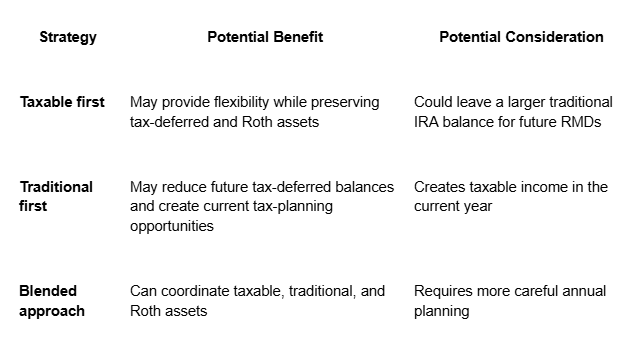
For example, a retiree might take enough from a traditional IRA to fill a desired tax bracket while supplementing the remainder of their spending from taxable or Roth assets.
Another year might call for a different combination based on investment performance, tax circumstances, Social Security, Medicare, or unexpected expenses.
The example is intentionally simplified. The appropriate strategy would depend on the retiree's tax situation, income sources, investment allocation, healthcare considerations, charitable goals, estate plan, and expected future spending.
The point isn't that one strategy is universally better. The point is that withdrawal order can be a planning decision rather than an automatic rule.
Retirement withdrawals aren't limited to ordinary portfolio spending.
For retirees who are charitably inclined, Qualified Charitable Distributions (QCDs) may also be worth discussing with an appropriate tax professional. Under applicable rules, an eligible IRA owner may make a qualifying charitable distribution directly from an IRA, and a QCD can count toward an RMD.
Beneficiary and estate-planning considerations can also affect whether preserving certain accounts makes sense.
Some common mistakes include:
A retirement income strategy should be reviewed as circumstances change.
There is no universal answer to which retirement account you should withdraw from first.
Your strategy may involve a combination of taxable investments, traditional IRAs, 401(k) accounts, Roth IRAs, Social Security, pensions, and other income sources.
The key is understanding how each account works and how withdrawals affect your taxes, investments, healthcare costs, RMDs, and long-term financial goals.
A properly structured asset management and wealth management strategy can help coordinate these decisions rather than treating each account separately.
If you're considering transferring a 401(k) to an IRA, completing a 401(k) rollover to a Roth IRA, or simply deciding how to fund retirement expenses, it's worth evaluating the tax and investment consequences before making a major account change.
At Legacy Wealth Management, we help individuals and families coordinate retirement income, investment management, tax considerations, and broader wealth planning.
Our services may include:
As an independent wealth management firm serving clients in Virginia, our approach is designed around the individual's goals, financial circumstances, and long-term needs.
If you're searching for Virginia wealth management, wealth management near me, a wealth management advisor, or retirement planning and wealth services, understanding the available options—and the associated wealth management fees and investment costs—is an important part of evaluating any financial professional.
If you'd like help reviewing your retirement strategy, or understanding how to find a fiduciary financial advisor aligned with your goals, you can schedule a complimentary meeting by visiting www.lwealthmanagement.com/contact or calling (877) 650-4738.


Ready to take the first step in your financial journey? Speak with one of our advisors today.