

For most of your career, your paycheck arrives on a predictable schedule. You know when money is coming in, what your expenses are, and how much you can save or invest.
Then retirement arrives—and that career paycheck stops.
Your expenses don't stop, however. Housing, healthcare, groceries, insurance, travel, and the things you enjoy doing still need to be paid for. The difference is that you may now need to create your own paycheck using the assets and income sources you've accumulated over decades.
That transition is one of the most important parts of retirement planning. Building a retirement paycheck isn't simply about choosing the right investments. It means coordinating Social Security, pensions, retirement accounts, investment portfolios, taxes, cash reserves, spending needs, and long-term goals.
In other words, retirement isn't just about how much you've saved. It's about how effectively your financial resources can work together to support the retirement you want.
During your working years, much of your financial focus may be on accumulating assets. You contribute to a 401(k), IRA, or investment account and watch your investment portfolio grow over time.
Retirement changes the question.
Instead of asking, "How much can I accumulate?", you may need to ask, "How can I turn what I've accumulated into income?"
Your potential retirement income sources may include:
The goal isn't necessarily to make every account produce income at the same time. Instead, investment planning can help determine how these different resources may work together.
Before deciding how to invest or which accounts to withdraw from, it helps to determine how much income your retirement lifestyle may require each month. Start by separating expenses into essential costs, discretionary spending, and irregular expenses such as travel, home repairs, or major purchases.
For example, suppose a hypothetical household expects to spend $8,000 per month in retirement. That amount may not need to come entirely from an investment portfolio. Instead, the household could coordinate several income sources:
Where Your Retirement Paycheck Comes From
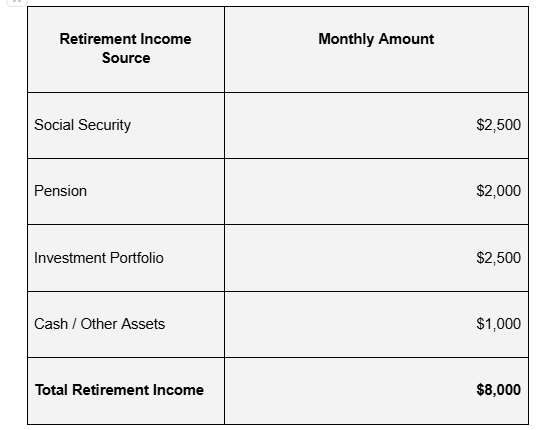
Illustrative example only. Actual retirement income needs and sources will vary based on an individual's circumstances.
The important takeaway is that a retirement paycheck doesn't necessarily have to come from one account or investment. Retirement income can be created by coordinating multiple sources, each serving a different role in the overall plan.
Social Security can be an important part of a retirement income strategy. The timing of when you claim benefits can affect the amount you receive, making Social Security an important planning decision rather than simply an automatic retirement step.
Pension income can provide another source of predictable cash flow for individuals who have access to a pension.
Your investment portfolio may then be responsible for filling some or all of the remaining income gap.
This leads to an important question:
How much of your essential retirement spending is covered by predictable income, and how much needs to come from your investments?
Understanding that number can help provide context for your investment management strategy.
It can also help determine how much liquidity and investment risk may be appropriate for your circumstances.
One way to think about retirement portfolio management is to recognize that not every dollar needs to serve the same purpose.
Some assets may be intended for near-term expenses. Others may be invested for longer-term growth. Still others may be reserved for unexpected costs or legacy goals.
For example, a retirement strategy might include:
Short-term assets: Cash or relatively conservative investments intended to cover near-term spending.
Intermediate assets: Investments designed to support income needs over the next several years.
Long-term assets: Growth-oriented investments intended to help address inflation and provide resources for later retirement.
This doesn't necessarily mean maintaining three separate accounts or using a particular investment product. It is a way of thinking about how your assets are intended to support different financial needs.
Your appropriate allocation will depend on factors such as your financial resources, income needs, risk tolerance, liquidity requirements, and time horizon.
A $5,000 withdrawal doesn't necessarily mean you have $5,000 available to spend.
Traditional IRAs and many retirement plans generally create taxable income when distributions are taken, subject to applicable rules and exceptions. Qualified Roth IRA distributions can generally be tax-free, while taxable investment accounts may generate interest, dividends, and capital gains.
That makes tax planning an important part of retirement income planning.
Rather than automatically withdrawing from the same account every year, your strategy may need to coordinate taxable investment accounts, traditional retirement accounts, and Roth assets.
Required minimum distributions also need to be incorporated into the plan.
Ultimately, retirement income should be considered on an after-tax basis. The amount that matters to your lifestyle is the amount you actually have available to spend—not simply the amount withdrawn from an account.
One of the challenges of retirement investing is sequence-of-returns risk.
Consider two retirees with similar portfolios. Both experience the same average investment return over a long period. If one experiences significant market losses early in retirement while taking withdrawals, that sequence of returns can put greater pressure on the portfolio than if those losses occurred later.
This is one reason retirement planning involves more than selecting investments.
Your withdrawal strategy, cash reserves, portfolio allocation, and other income sources can all matter when markets are volatile.
No investment strategy can eliminate market risk. However, thoughtful retirement investment planning can take the timing of withdrawals and market fluctuations into consideration.
A retirement paycheck that covers your expenses today may not provide the same purchasing power years from now.
Inflation can increase the cost of housing, food, healthcare, insurance, and other necessities over a long retirement. Your financial plan therefore needs to consider not only today's income needs but also how those needs could change over time.
Healthcare is another major consideration. Medicare and supplemental coverage can help with many healthcare expenses, but retirees can still face premiums, deductibles, copayments, prescriptions, and other out-of-pocket costs.
Long-term care is another potential expense that should be considered as part of comprehensive retirement planning.
Longevity matters as well. Retirement assets may need to support you for decades. A strategy that works for the first few years of retirement may need to evolve as your circumstances change.
This is why retirement planning should look beyond the first year or two of retirement and consider the entire period your assets may need to support you.
Many people searching for retirement advice want to know which investments are the "safest."
The challenge is that there isn't one investment that is safest for every retiree.
Cash may provide liquidity but limited long-term growth. Bonds can provide income but carry interest-rate and credit risks. Stocks provide greater growth potential but fluctuate in value. Annuities may provide contractual guarantees depending on the product but can also have fees, restrictions, and other considerations.
Rather than looking for one "safe investment," retirement planning can focus on how different types of assets work together.
The objective is to build a strategy around your income needs, financial resources, risk tolerance, and retirement goals.
Managing investments during retirement can involve different considerations than managing investments while you're working.
During your career, you may have been able to continue contributing to your investment portfolio during market declines. Once you're retired, you may also be taking money out of that portfolio to pay for living expenses.
That makes investment management and portfolio management particularly important.
The portfolio needs to balance several competing objectives: providing liquidity, supporting current income, maintaining growth potential, managing investment risk, and helping assets last throughout retirement.
There is no universal investment portfolio that is appropriate for every retiree.
Instead, investment decisions should reflect the individual's goals, time horizon, risk tolerance, liquidity needs, and broader financial circumstances.
If you're searching for an investment advisor near me, investment fiduciary near me, or retirement planning near me, you'll likely find many different types of financial professionals.
Rather than relying solely on phrases such as "best investment advisors," "best retirement advisors," or investment advisor reviews, consider researching:
For many retirees, the important question isn't simply who can manage investments. It's whether the advisor understands how investment management, retirement income, tax considerations, and long-term financial goals fit together.
A registered investment advisor or other financial professional may provide services that go beyond investment selection, depending on the firm's structure and services.
Retirement doesn't necessarily follow a straight line.
Your spending may change. Markets will fluctuate. Inflation can affect purchasing power. Healthcare expenses may increase. Tax laws can change. Your priorities may evolve.
That's why your retirement paycheck may need to be reviewed and adjusted over time.
Ongoing wealth management, investment management, and financial planning can provide a framework for reviewing whether your strategy continues to fit your circumstances.
The objective isn't necessarily to predict what will happen years from now. It's to build a financial strategy that can be reviewed and adjusted as your retirement evolves.
Your retirement paycheck shouldn't be viewed as coming from one account or one investment.
It may come from Social Security, a pension, retirement accounts, taxable investments, cash reserves, and other assets.
The challenge is determining how those pieces should work together.
For a hypothetical couple needing $90,000 per year, Social Security and pension income might provide $45,000. Their investment accounts would then need to help provide the remaining $45,000.
How that $45,000 is generated could depend on their tax situation, account types, investment portfolio, spending needs, risk tolerance, and other goals.
This is why retirement planning and investment planning go beyond simply asking, "What should I invest in?"
The more important question may be:
How can my entire financial picture work together to support the retirement I want?
For individuals searching for retirement planning Northern VA, investment advisor near me, investment services, or private wealth management, retirement can be an important time to step back and look at the entire financial picture.
At Legacy Wealth Management, retirement planning can involve more than managing an investment portfolio. It can include reviewing retirement income sources, investment management, retirement accounts, spending needs, tax considerations, and longer-term financial objectives.
Whether you're several years from retirement or already retired, creating a strategy for turning your accumulated assets into retirement income can help you better understand how your financial resources may support the life you want to live.
If you'd like help reviewing your retirement strategy, or understanding how to find a fiduciary financial advisor aligned with your goals, you can schedule a complimentary meeting by visiting www.lwealthmanagement.com/contact or calling (877) 650-4738.

.svg)
Ready to take the first step in your financial journey? Speak with one of our advisors today.